By Brajesh Jha, RPH, MSHCA, MBA
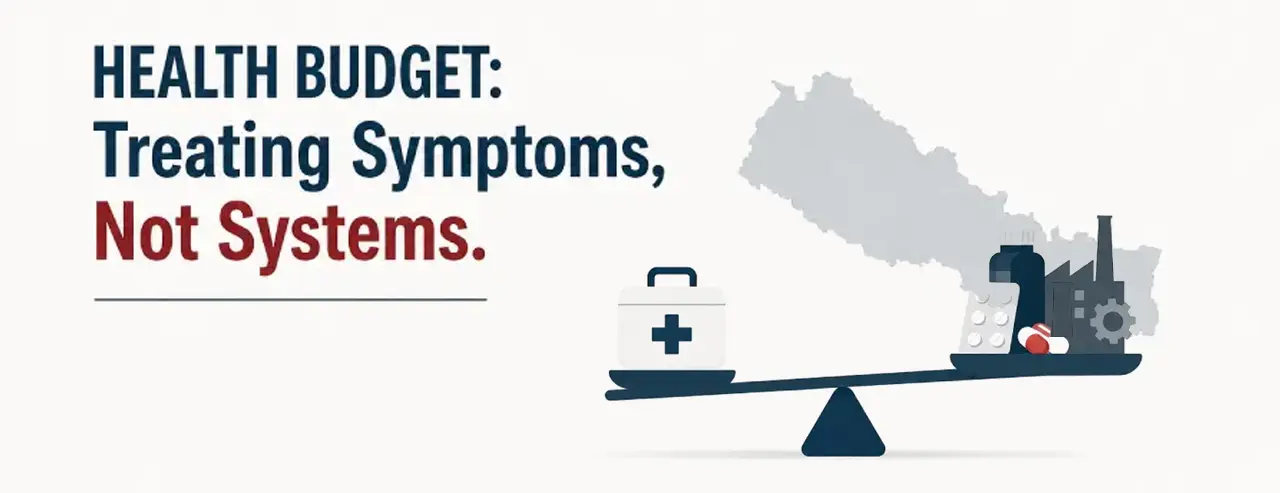
Nepal’s fiscal year 2025/26 budget places notable emphasis on expanding access to healthcare, reflecting a clear political commitment to building a more inclusive public health system. At first glance, the health sector emerges as one of the stronger pillars of the budget, supported by increased spending, expanded insurance coverage, and improved service delivery. However, a closer reading reveals a critical omission: the absence of a coherent strategy for the pharmaceutical sector, which underpins the very effectiveness of these health initiatives.
The budget presents an ambitious vision for healthcare access, prioritizing free basic services, expanded primary facilities, and stronger specialized care. Increased investment in non-communicable diseases and a Rs. 95.81 billion allocation highlight health as a core development priority. Reforms to the Health Insurance Program, along with efforts to expand telemedicine, aim to improve access in underserved areas. Continued provision of free essential medicines, upgrades in laboratory capacity, and strengthened preparedness for infectious diseases further reflect a focus on affordability, quality, and resilience.
Yet, these commendable initiatives rest on a fragile foundation. The budget’s approach to healthcare is heavily service-oriented, with limited attention to the supply side of medicines and medical products. While there is mention of “facilitating domestic production of essential medicines” and strengthening regulatory bodies like the National Drug Laboratory, these measures lack depth, scale, and a strategic framework.
This limited engagement with the pharmaceutical sector is a serious oversight. Nepal remains heavily dependent on imported medicines, leaving the health system vulnerable to external supply disruptions and price fluctuations. Expanding insurance coverage and hospital infrastructure without ensuring a reliable domestic pharmaceutical base risk creating a system where services exist, but essential inputs remain uncertain or costly.
The gap becomes even more apparent when compared to other sectors. The budget offers targeted policy incentives for industries such as information technology, hydropower, and manufacturing, yet pharmaceuticals, despite being critical to national health security, receive no comparable policy thrust. There are no major tax incentives, no clear roadmap for research and development, and no initiative to build pharmaceutical supply chain clusters or promote exports.
This lack of focus is not merely a missed economic opportunity; it is a public health risk. A robust pharmaceutical sector could reduce dependency on imports, stabilize drug prices, and ensure uninterrupted supply during emergencies. It could also generate skilled employment and contribute to economic diversification, goals that the budget itself repeatedly emphasizes in other contexts.
In essence, the health component of Nepal’s 2025/26 budget succeeds in expanding access and improving service delivery but falls short in addressing structural sustainability. Healthcare cannot function in isolation from the supply chain that supports it. Without a strong pharmaceutical backbone, the vision of universal, affordable, and quality healthcare remains incomplete.
As Nepal moves forward, policymakers must recognize that health security and supply chain policy are deeply interconnected. Future budgets should go beyond hospitals and insurance schemes to invest in domestic pharmaceutical capacity, research, and innovation. Only then can the country build a health system that is not just accessible, but truly self-reliant and resilient.
About the Author
Brajesh Jha is a healthcare operations professional and pharmacist with extensive experience across hospital pharmacy, supply chain management, and healthcare system implementation in Nepal. He currently serves as a System Implementation Coordinator at Pharma Life, where he focuses on optimizing operational workflows, deploying healthcare software systems, and improving efficiency across network pharmacies.
With a background that includes hospital pharmacy practice, academic roles in healthcare management, and entrepreneurial experience as the founder of a community pharmacy during the COVID-19 pandemic, he brings a practical, systems-oriented perspective to healthcare challenges.
He holds a Bachelor of Pharmacy, a Master’s in Health Care Administration, and an MBA, with academic work centered on digital transformation in pharmaceutical supply chains. His work and commentary focus on making healthcare operations more efficient, data-driven, and reliable.